
Imagine logging into your workstation on a Monday morning. Instead of confronting a chaotic mountain of unread emails, scheduling conflicts, and incomplete data reports, you find a clean, prioritized summary. A digital assistant has already sorted your hot leads, drafted context-aware responses to routine client inquiries, cross-referenced three conflicting calendar invites to find an optimal slot, and updated your team dashboard with last week’s performance metrics.
This isn’t a futuristic concept for the next decade; it is the reality of the workplace right now!
Over the last few years, we have lived through the initial wave of Generative AI, mostly characterized by interactive chatbots like ChatGPT. However, we have officially entered a new era. Industry research from the Gartner 2026 Supply Chain Technology Trends highlights a massive shift toward Agentic AI: intelligent, self-directed systems capable of moving beyond simple insights into actual, multi-step execution.
The best part? You do not need a degree in software engineering or any coding background to leverage this shift. Modern autonomous agents are designed to understand natural human language, integrate seamlessly with the tools you already use, and take over the repetitive administrative tasks that drain your creative energy.
Chatbots vs. Agents: What’s the Real Difference?
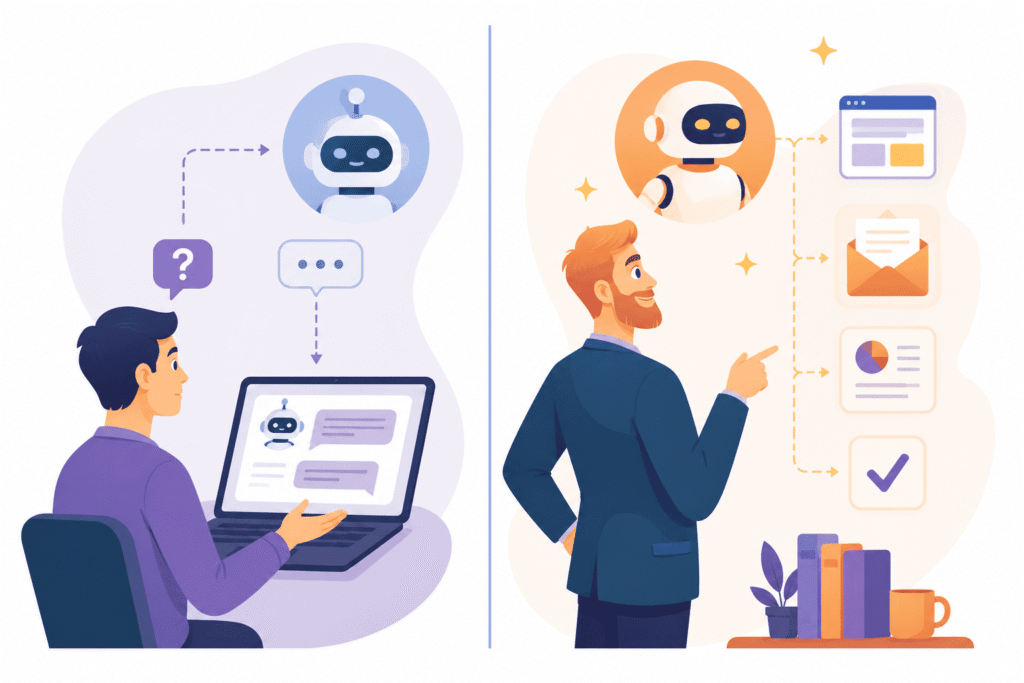
To effectively harness this technology, it helps to understand the fundamental shift that has occurred.
For much of the recent past, using AI felt like working with a calculator: it only produced an output when you manually typed in a direct prompt. If you wanted to compile a report, you had to ask the chatbot to write a section, copy it, prompt it for the next section, find data yourself, and manually piece it together.
An autonomous AI agent, by contrast, functions less like a software tool and more like a real-life project assistant. Instead of giving it step-by-step instructions, you give it an ultimate goal and the necessary boundaries. The agent then independently determines the required steps, executes them across different software applications, handles unexpected errors, and presents you with the finished product.
According to data published in the Microsoft 2026 Work Trend Index, as AI agents take on more tactical execution, the nature of human work is fundamentally changing. We are shifting from being the mechanical “operators” who execute repetitive tasks to “architects” who direct the workflow and evaluate the final quality.
5 Workflows You Can Delegate to AI Agents Today
If you want to reclaim at least an hour of your workday, here are five common, high-friction B2B workflows that autonomous agents can manage independently right now.
1. Smart Inbox Triaging & Draft Generation
- The Pain Point: The modern professional is caught in an “infinite workday” of communication overload, frequently spending the first two hours of every morning just sorting through internal and external emails.
- The Agent Solution: Instead of basic spam filters, incoming emails are analyzed by an agent that understands context and business intent. It automatically categorizes emails (e.g., Urgent Client Issue, General Inquiry, Vendor Pitch), assigns priority scores, and dynamically drafts contextually accurate responses.
- The Result: When you open your inbox, your routine replies are already written and sitting in your drafts folder. All that is left for you to do is review, tweak if necessary, and hit send.
2. Automated Lead Enrichment and CRM Maintenance
- The Pain Point: Business development and sales teams lose hours of productive time performing manual data entry: looking up a new lead on LinkedIn, finding company sizes, tracking down funding rounds, and manually typing that information into Salesforce or HubSpot.
- The Agent Solution: An autonomous agent can be triggered the exact moment a new lead fills out a contact form on your website. The agent independently searches public business directories, analyzes the company’s digital footprint, extracts key decision-makers, and populates your CRM with enriched profiles.
- The Result: Sales reps spend zero time on administrative research and can focus entirely on high-value human interactions and closing deals.
3. Cross-Platform Meeting Coordination & Action Tracking
- The Pain Point: The endless, frustrating back-and-forth email chains attempting to coordinate a meeting across different organizations, time zones, and external calendars.
- The Agent Solution: Multi-agent systems can interact with one another or securely read public availability data. They negotiate optimal meeting times, send out the invites, track RSVPs, and seamlessly update cross-functional workspaces like Slack or Microsoft Teams with the meeting details.
- The Result: The logistical headache of calendar management is completely automated, ensuring meetings are scheduled without human intervention.
4. Continuous Market Intelligence & Competitor Tracking
- The Pain Point: Keeping up with industry news, regulatory changes, or sudden pricing and product shifts from direct competitors requires constant, manual web browsing.
- The Agent Solution: Web-scouting agents can be deployed to monitor targeted competitor websites, industry blogs, and press releases 24/7. Rather than just alerting you with raw links, the agent synthesizes the findings.
- The Result: You receive a concise, bulleted intelligence brief every Friday morning detailing precisely what changed in your market space and why it matters to your business strategy.
5. Expense Categorization & Receipt Matching
- The Pain Point: Gathering corporate receipts, matching them to corporate credit card statements, and typing out expense reports at the end of every month.
- The Agent Solution: Financial agents automatically scan your digital inbox or cloud folders for receipts, read the line items using optical character recognition (OCR), cross-reference them against corporate bank feeds, categorize the expense type according to company policy, and log them into accounting software like Xero or QuickBooks.
- The Result: The entire reconciliation pipeline runs smoothly in the background, leaving humans to only intervene when a discrepancy or policy violation occurs.
The Human Factor: Managing Your Digital Assistants
Delegating to an autonomous agent does not mean removing human oversight. In fact, leading organizations are championing the “Human-in-the-Loop“ principle. Think of an AI agent as a brilliant, lightning-fast, but occasionally overeager intern. They can process data at unprecedented speeds, but they lack your institutional knowledge, strategic intuition, and cultural nuance.
To successfully manage agents in a professional environment, keep these best practices in mind:
- Start Small: Do not try to automate your entire business model overnight. Pick one highly predictable, repetitive workflow (such as lead enrichment) and perfect it before moving to more complex pipelines.
- Implement Approval Gates: For workflows that interact directly with clients or external stakeholders (like sending emails or publishing content), always configure the agent to require a manual “human click” before execution.
- Prioritize Quality Control: The 2026 Work Trend Index research from Microsoft shows that professionals rank “quality control of AI output” and “critical thinking” as the two most vital human workplace skills today. Your value lies in evaluating and refining the agent’s work, not doing the heavy lifting yourself.
Conclusion: Emphasizing Strategy Over Administration
The ultimate goal of adopting autonomous agents is not to eliminate the human element from business, but rather to protect it. By delegating tactical execution to intelligent systems, you free up cognitive space for the things that software cannot replicate: creative problem-solving, long-term strategic planning, and building deep, empathetic relationships with your clients and partners.
Take a look at your calendar this week. Identify the single most repetitive, uninspiring administrative task that consistently slows you down. Explore built-in agent features within your existing enterprise software, or look into accessible automation platforms, and delegate that workflow. Reclaim your first hour, and shift your focus back to what truly drives your business forward.
To explore these organizational shifts and get a deeper understanding of how modern business leaders are restructuring their teams to balance human intuition with agentic execution, check out this panel discussion on the 2026 Work Trend Index. This video is highly relevant as it features prominent AI thought leaders discussing the exact transition from mechanical execution to strategic oversight detailed in this article.
If you want to learn more about AI Agents, please take a look at our article “The Rise of AI Sidekicks in 2025“.